Did you know that sewage treatment plant in Nagpur earns a staggering ₹300 crore every year from its sewage? While most cities in India struggle to manage wastewater—letting it pollute rivers and deplete precious freshwater resources—Nagpur has quietly transformed this liability into a remarkable revenue stream .
For decades, Indian cities have treated sewage as an afterthought. The result? Polluted rivers, groundwater contamination, and a growing freshwater crisis that affects millions. But Nagpur, the “Orange City,” has broken this cycle to become a national leader in wastewater management.
How did they do it? What can other cities learn from Nagpur’s journey? And what challenges still lie ahead?
This comprehensive guide explores Nagpur’s path from pollution to profit, dissecting the landmark projects, cutting-edge technologies, ground-level challenges, and what this means for the future of urban India.
Table of Contents
The “Waste-to-Wealth” Model: How Nagpur Earns ₹300 Crore from Sewage
The Economics of Treated Water
At the heart of Nagpur’s success lies a simple yet revolutionary idea: treated sewage is not waste—it’s a valuable resource. The city has built a circular economy model that generates substantial revenue while conserving freshwater for its citizens .
The key partnership driving this transformation is between the Nagpur Municipal Corporation (NMC) and the Maharashtra State Power Generation Company (MAHAGENCO) . In 2008, these two entities signed a landmark memorandum of understanding that would change the city’s wastewater landscape forever .
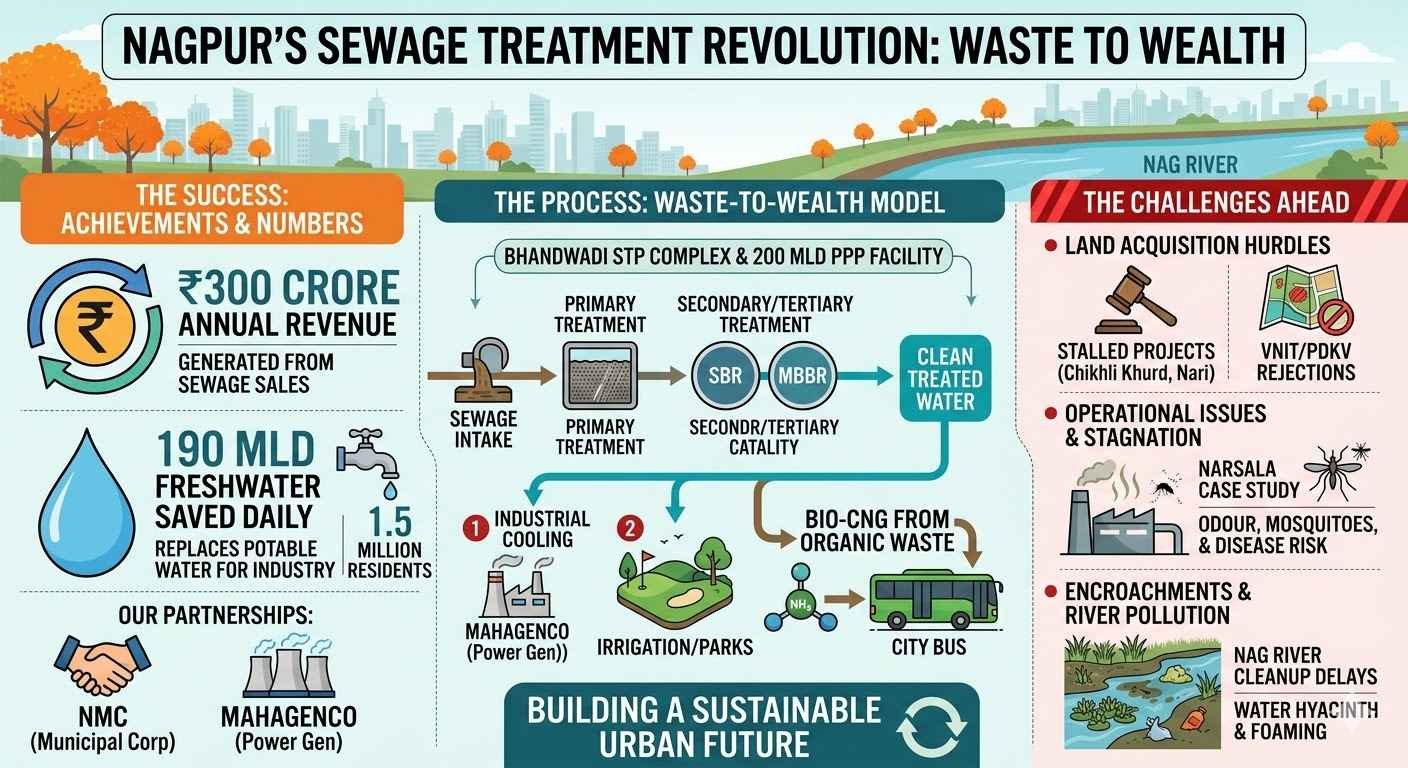
Under this agreement, MAHAGENCO co-funded a 130 MLD (million litres per day) tertiary treatment plant at Bhandewadi. In exchange, the power company purchases the treated water for use at its Koradi and Khaparkheda thermal power plants. Today, MAHAGENCO pays an annual royalty to NMC for this water, contributing significantly to that ₹300 crore figure .
The Numbers That Matter
Let’s look at the scale of this operation:
- Sewage generation: 520-550 MLD daily
- Current treatment capacity: Approximately 330 MLD
- Freshwater saved: 190 MLD of potable water daily
- Annual revenue: ₹300 crore
- People served indirectly: The freshwater saved could meet the needs of at least 1.5 million residents
“In Nagpur, the municipal body is earning ₹300 crore annually by treating sewage and selling it to industries in the nearby areas,” said Union Minister Nitin Gadkari, lauding the city’s innovative approach .
The treated water supplied to power plants replaces freshwater that would otherwise be drawn from rivers or groundwater. This means more clean water for Nagpur’s households and a reduced environmental footprint for the industries involved .
Beyond Water: Bio-CNG from Organic Waste
Nagpur didn’t stop at sewage treatment. The city also collects organic waste from markets, homes, and restaurants, feeding it into special bio-digesters. Inside these digesters, bacteria break down the waste and release methane gas, which is then cleaned and turned into bio-CNG—a renewable fuel already powering city buses and generators .
This integrated approach means:
- Less garbage on the streets
- Less pollution in the air
- Less money spent on fossil fuels
- New jobs in waste collection and biofuel production
The Infrastructure Behind the Miracle
The Flagship: Bhandewadi’s Sewage Treatment Plant in Nagpur, STP Complex
The Bhandewadi plant stands as the crown jewel of Nagpur’s sewage treatment infrastructure. With a capacity of 130 MLD (designed for flexibility up to 200 MLD), this facility processes a significant portion of the city’s sewage using advanced technologies .
The plant employs Sequencing Batch Reactors (SBR) with tertiary treatment to ensure the treated water meets stringent quality standards suitable for industrial cooling and construction purposes . This level of treatment is crucial—power plants require water that won’t corrode their equipment, and construction sites need water that won’t compromise concrete quality.
The 200 MLD Public-Private Partnership Facility
Building on the success of Bhandewadi, Nagpur developed a modern 200 MLD facility under a public-private partnership model. This plant further expanded the city’s treatment capacity and demonstrated the viability of involving private operators in municipal infrastructure .
The tripartite agreement between NMC, MAHAGENCO, and private operators has become a template for other cities to follow. It shows how strategic partnerships can convert urban waste challenges into significant economic opportunities .
Treatment Technologies in Action
Nagpur’s STPs utilize a range of advanced technologies to achieve high-quality effluent:
The treatment process follows three stages:
- Primary treatment: Solids are separated from the wastewater stream
- Secondary treatment: Dissolved biological matter is converted into solid mass using micro-organisms
- Tertiary treatment: Water is disinfected chemically or physically
The final effluent is clean enough for industrial cooling, irrigation of golf courses and parks, groundwater recharge, or agricultural purposes .
The Future: AMRUT 2.0 and Regional Expansion
The ₹957 Crore South Nagpur Project
Nagpur isn’t resting on its laurels. Under the AMRUT 2.0 scheme, the city is undertaking a massive ₹957.01 crore project to serve 8.50 lakh people in southwest Nagpur .
The scope of this project is staggering:
- 417 kilometres of new sewer pipelines
- A 35 MLD STP at Chikhli (currently facing legal challenges)
- A 10 MLD STP at Jaitala
The project aims to lay more than 500km of sewer pipelines across south and south-west Nagpur by July 2026, bringing modern sanitation to rapidly expanding residential areas .
15 Towns to Get STPs Under Swachh Bharat Mission
Nagpur’s success is now influencing the broader region. Under the Swachh Bharat Mission (Urban) 2.0, 15 Urban Local Bodies in the Nagpur division will receive modern Sewage Treatment Plants .
These towns include:
- Kamptee
- Katol
- Saoner
- Ramtek
- Kalameshwar
The combined capacity of these new STPs will be 54 MLD, part of a larger state plan to achieve a total treatment capacity of 1,654 MLD across 358 Urban Local Bodies .
This integrated approach will relieve Nagpur’s rivers—Nag, Pili, and Pora—from excess sewage inflow, benefiting both the city and its neighbours .
The Nag River Pollution Abatement Project
Perhaps the most ambitious initiative is the ₹1,927 crore Nag River Pollution Abatement Project, championed by Union Minister Nitin Gadkari . This project aims to rejuvenate the heavily polluted Nag River by stopping the flow of untreated sewage into it.
Key proposed STPs under this project include:
- Nari: A 45 MLD STP on the bank of the Pili River
- VNIT: A 12 MLD STP (land acquisition pending)
- PDKV: A 35 MLD STP (land acquisition pending)
The project involves laying special interceptor pipelines alongside the rivers to carry sewage to treatment plants. However, this work could be obstructed by permanent structures and encroachments in riverbeds, which the NMC has committed to clearing where necessary .
Municipal Commissioner Abhijeet Chaudhari has stated that “unauthorized extensions by homeowners have choked sewer lines, disrupting the flow of wastewater and allowing untreated sewage to pollute the rivers” . These encroachments will have to be removed to eliminate recurring complaints related to sewerage blockages.
The Ground Reality: Challenges and Roadblocks
For all its successes, Nagpur’s sewage treatment journey hasn’t been smooth sailing. Several significant challenges threaten to derail progress and offer important lessons for other cities.
The Land Acquisition Hurdle
The Chikhli Khurd STP Delay
The proposed 35 MLD STP at Chikhli Khurd, intended to reduce pollution in the Pora River, has run into legal trouble. The NMC is acquiring 31,025 square metres of private land for the project and has fixed ₹11.77 crore as compensation. However, the project stalled after one of the landowners challenged the acquisition process in the High Court .
The dispute dates back to 2015, when landowner Ganesh Sachyani wrote to the NMC’s town planning department seeking removal of the STP reservation from his land. Despite this, the NMC proceeded with the acquisition and awarded about ₹11 crore as compensation for three land parcels owned by Sachyani. Officials also face difficulty tracing another landowner linked to the acquisition .
The Nari STP Stalemate
Similarly, the 45 MLD STP planned at Nari faces delays as the NMC seeks to change the land use of a public park for the facility .
VNIT and PDKV Rejections
Both VNIT (Visvesvaraya National Institute of Technology) and PDKV (Panjabrao Deshmukh Krishi Vidyapeeth) have expressed their inability to spare land for proposed STPs, forcing the NMC to find alternative sites .
When STPs Become a “Curse”: The Narsala Case Study
Perhaps the most cautionary tale comes from the newly constructed STP on the Pohra River in Narsala. Rather than solving problems, this facility has created new ones for local residents .
Residents report:
- Bad odour emanating from the plant
- Mosquito breeding leading to diseases like Malaria and Dengue
- Contaminated groundwater affecting local wells
“We are battling this issue since the time of the construction of STP. Now though it is complete, the issue refuses to die. Many residents in the locality are suffering from diseases like Malaria, Dengue, Chikungunya, etc.” — Santosh Verma, Narsala resident
The problem stems from stagnant water in and around the facility, which has become a health hazard to nearby residential areas. Despite repeated complaints, residents say no action has been taken by the civic body .
Local activist Adv Rasika Barahate calls it “a perfect example of mindless planning of NMC which is now creating problems for nearby residents” .
The Pohra River’s Slow Death
The Pohra River itself tells a sad tale of unplanned urban expansion at the cost of natural water streams. As the second tributary of the Nag River, it flows from Yashoda Nagar through Jaitala Road, Trimurti Nagar, Sahakar Nagar, Somalwada, Manish Nagar, Besa, and Narsala before joining the Nag .
In the absence of natural water flow, sewage is now the only source of water in the river. A fact check by The Hitavada found sewage water stagnant at many stretches, with plastic and other solid waste floating in the water body—making it not only an eyesore but also a health hazard .
The worst scene was noticed near Pipla village, where toxic froth in the Pohra River gave an alarming signal. Like Ambazari lake and Nag River, the Pohra has also become a victim of Eichhornia weeds (water hyacinth), which choke the water body and hamper STP operations .
The frothing occurs due to release of industrial effluent containing high concentrations of detergents. Environmental experts warn that detergents destroy the external mucus layer protecting fish from bacteria and parasites, and can cause gill damage. “Fishes will die when detergent concentration reaches 15 ppm phosphates,” explains Surbhi Jaiswal of the Green Vigil Foundation .
Encroachments and Infrastructure Challenges
The river cleanup efforts face another obstacle: encroachments. Municipal Commissioner Abhijeet Chaudhari has acknowledged that “unauthorized extensions by homeowners have choked sewer lines, disrupting the flow of wastewater and allowing untreated sewage to pollute the rivers” .
These encroachments will need to be cleared to lay interceptor pipelines alongside the rivers. The NMC assures that no one will be displaced unnecessarily, and no other constructions will be disturbed—but the challenge remains significant .
Lessons Learned
The Narsala case offers crucial lessons for urban infrastructure planning:
- Community engagement matters: Projects planned without considering local impact face resistance and may fail to deliver benefits
- Operation is as important as construction: Building an STP is only half the battle; ensuring it operates correctly is equally crucial
- Maintenance prevents problems: Regular monitoring and maintenance can prevent facilities from becoming health hazards
- Site selection is critical: STPs need appropriate locations with buffer zones to protect nearby residents
Why This Matters to You
For Real Estate Developers and Housing Societies
With the NMC and National Green Tribunal increasing scrutiny on water bodies like Futala and Ambazari lakes, decentralized STPs are becoming essential for new developments. Housing societies and commercial complexes can no longer rely solely on municipal infrastructure—they need on-site treatment solutions .
Key considerations:
- Space-efficient designs: Package STPs (5 KLD to 500 KLD) offer compact solutions for medium-scale developments
- Easy operation: Semi-automatic systems minimize manpower requirements
- Reuse potential: Treated water can be used for gardening, flushing, and landscaping, reducing freshwater bills
For Hoteliers and Industrialists
Rising freshwater costs and strict pollution board norms make water reuse a financial necessity. Industries and hotels generating significant wastewater can:
- Install MBBR or SBR-based systems for reliable treatment
- Reuse treated water for cooling, washing, or processing
- Achieve compliance with CPCB discharge standards
- Reduce dependence on municipal water supply
For Citizens
Proper sewage treatment directly impacts the health of local rivers and groundwater. When STPs fail—as in Narsala—nearby residents suffer from odour, mosquitoes, and contaminated water. When they work—as in the Bhandewadi model—everyone benefits from cleaner rivers and more freshwater availability .
For Policymakers and Urban Planners
Nagpur’s experience offers valuable lessons for other cities:
- Public-private partnerships can work when structured properly
- Revenue generation from treated wastewater makes STPs financially sustainable
- Land acquisition must be addressed early in project planning
- Community concerns cannot be ignored in infrastructure development
- Integrated planning across municipal boundaries benefits entire regions
Conclusion
Nagpur’s sewage treatment journey presents a study in contrasts. On one hand, the city has achieved what few Indian cities have: a circular economy model that generates ₹300 crore annually from wastewater while conserving 190 MLD of freshwater for its citizens. The partnership between NMC and MAHAGENCO, the advanced treatment technologies, and the vision to see waste as a resource—all these elements position Nagpur as a national leader .
On the other hand, the city grapples with land acquisition hurdles, legal challenges, and operational failures like the Narsala STP, which has become a “curse” for nearby residents rather than a solution . The ambitious Nag River rejuvenation project, despite its ₹1,927 crore price tag, has yet to show significant on-ground results due to these obstacles .
As Nagpur expands towards Hingna and the Samruddhi corridor, and as 15 surrounding towns prepare to receive new STPs under the Swachh Bharat Mission, a critical question emerges:
Will we replicate the successes of Bhandewadi or the failures of Narsala?
The answer lies in smarter planning, community engagement, and choosing the right partners for execution. Infrastructure is not just about concrete and pipes—it’s about people, environment, and sustainable futures.
Want to stay updated on Nagpur’s infrastructure evolution? Bookmark this page or subscribe to our newsletter for more in-depth analysis of urban development, wastewater management, and sustainable technologies.
If you are a developer, hotelier, or industrialist looking for a reliable, space-efficient Sewage Treatment Plant in Nagpur, our team of experts can help. We offer customized solutions tailored to your specific needs, with advanced technologies including MBBR, SBR, and MBR systems.
Contact us today for a free consultation and plant design. Let’s work together to ensure that Nagpur’s next STP story is one of success, not struggle.