How to Choose the Right Sewage Treatment Plant STP for Your Business? Swami Engineering Services are here to help.
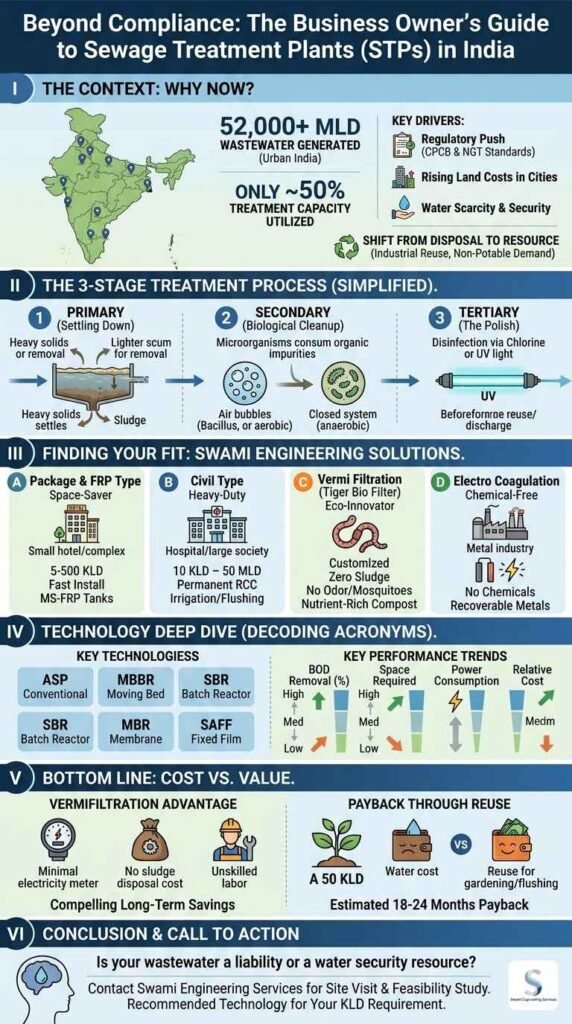
India’s wastewater sector is at an inflection point. Urban India generates over 52,000 million litres per day (MLD) of wastewater, yet treatment capacity utilisation hovers around half that figure . For business owners—whether you run a 50-room hotel in Pune, manage a hospital in Chennai, or develop a housing complex on the outskirts of Bengaluru—this statistic carries a stark message: the era of wastewater neglect is over.
State Pollution Control Boards now mandate sewage treatment plants (STPs) as a statutory requirement for virtually every commercial and residential entity. Simultaneously, land prices in urban India have skyrocketed, making the sprawling treatment systems recommended by traditional consultants financially prohibitive.
This is the dilemma facing Indian business owners today: how to satisfy strict environmental norms without bankrupting your project on land acquisition and civil construction.
Swami Engineering Services has spent decades bridging this gap—designing, fabricating, and commissioning STPs that balance regulatory compliance with practical, space-saving economics. This guide will walk you through everything you need to know about selecting the right sewage treatment solution for your specific needs, from understanding the basic treatment process to comparing technologies like MBBR, SBR, and even vermi-filtration.
Table of Contents
II. The “Why Now” Factor: Understanding the Shift in Wastewater Treatment
The Regulatory Landscape
Why the sudden urgency? The Central Pollution Control Board (CPCB) has established specific discharge standards that treated water must meet: Biological Oxygen Demand (BOD) ≤ 10–20 mg/L, Total Suspended Solids (TSS) ≤ 10–50 mg/L, and Faecal Coliform ≤ 100–1,000 MPN/100ml . These aren’t merely suggestions—they’re enforceable limits with real consequences for non-compliance.
The National Green Tribunal (NGT) actively monitors compliance. Recent orders have directed the CPCB to align waste-to-energy guidelines with new Solid Waste Management Rules, while joint committees investigate sewage discharge into rivers like the Pawana in Maharashtra . The message is clear: regulatory enforcement is intensifying, not relaxing.
From Disposal to Resource
Forward-thinking businesses are shifting their mindset. Treated wastewater is no longer just something to dispose of—it’s a resource. The treated wastewater market in India, valued at around ₹630 million in 2021, is projected to reach nearly ₹1.9 billion by 2050 . This growth is driven by industrial reuse, urban non-potable demand, and tightening environmental norms.
When you invest in an STP, you’re not just buying compliance. You’re buying water security. Treated water can replace freshwater for irrigation, gardening, flushing, and industrial processes—reducing your monthly water bills and insulating your business from water scarcity risks.
III. Breaking Down the Science: The 3-Stage Treatment Process (Simplified)
Before diving into technology options, it helps to understand what happens inside any STP. Treatment occurs in three distinct stages:
Primary Treatment (The Settling Down)
Sewage enters a quiescent basin where physics takes over. Heavy solids—think sand, grit, and organic particles—settle to the bottom as sludge. Meanwhile, oils, grease, and lighter solids float to the surface for skimming removal. This physical separation prepares the wastewater for biological treatment.
Secondary Treatment (The Biological Cleanup)
This is where the real magic happens. Microorganisms—primarily Bacillus and Pseudomonas species—are introduced to consume dissolved and suspended organic impurities . These bacteria convert pollutants into carbon dioxide, water, and biomass. Secondary treatment can be aerobic (with oxygen, faster but energy-intensive) or anaerobic (without oxygen, slower but producing biogas) .
Tertiary Treatment (The Polish)
The final stage involves disinfection—chemically with chlorine or physically with UV light—to eliminate pathogens before discharge or reuse . Some advanced systems incorporate filtration to produce ultra-pure water suitable for sensitive applications.
IV. Navigating Your Options: Which STP is Right for You?
“One size does not fit all” in wastewater treatment. Your choice depends on space, budget, application, and regulatory requirements. Here are the options Swami Engineering offers, each designed for specific scenarios.
Option A: The Space-Saver (Package & FRP Type)
Best for: Labour camps, medium industries, housing complexes, small hotels
Capacity Range: 5 KLD – 500 KLD
Key Features:
- Semi-automatic operation
- Above-ground installation with MS-FRP or MSEP tanks
- Minimal civil work (only sewage collection tank required)
- Easy transport and rapid installation
Package plants are prefabricated in factories and delivered ready for commissioning. They’re ideal when you need a compliant solution quickly and can’t afford months of civil construction. The FRP (Fibreglass Reinforced Plastic) construction resists corrosion and provides decades of service life .
Option B: The Heavy-Duty Solution (Civil Type)
Best for: Large industries, hospitals, commercial complexes, large societies
Capacity Range: 10 KLD – 50 MLD
Key Features:
- Semi-automatic operation with minimum maintenance
- Underground or above-ground RCC construction
- Treated water suitable for irrigation, gardening, and flushing
- Engineered for decades of continuous operation
Civil-type plants represent the traditional approach—reinforced concrete structures built on-site. They’re appropriate when you have the land, need very large capacity (think 1 MLD and above), and want a permanent infrastructure asset .
Option C: The Eco-Innovator (Vermi Filtration – Tiger Bio Filter)
Best for: Eco-conscious projects, sites with unskilled labour, operations prioritising zero sludge
Capacity Range: Customised configurations
How It Works:
Vermifiltration uses earthworms to digest organic matter in sewage. The worms create a sustainable population, consuming waste and converting it into nutrient-rich vermicompost .
Advantages:
- 100% natural, economic, and eco-friendly
- High energy saving due to minimal electricity requirements
- Easy operations—unskilled labour can manage the system
- Minimum area requirement compared to other technologies
- No recirculation needed—single-run treatment
- No separate sludge handling or management
- Fully aerobic system means no odour, mosquitoes, or flies
- Nutrient-rich compost obtained periodically for gardening
- Treated water meets CPCB discharge standards
The Tiger Bio Filter represents a paradigm shift. While other technologies generate sludge that requires costly disposal, vermifiltration converts waste into a valuable byproduct. Residual sludge isn’t generated, eliminating disposal costs and environmental liability .
Option D: The Chemical-Free Future (Electro Coagulation)
Best for: Industrial applications with metal contaminants, sites wanting to avoid chemical handling
How It Works:
Electrocoagulation uses pairs of metal electrodes—anodes and cathodes—arranged in pairs. Through electrochemistry, the cathode oxidises while water reduces, coagulating pollutants without chemical addition.
Advantages:
- Better quality effluent than chemical coagulation
- No residual chemicals in effluent—eliminating toxins and odours
- No thickener required, reducing upfront costs
- Metals can be recovered from solution in usable form
- Low electrical current requirement—can be powered by green energy
For industries dealing with metal-finishing wastewater or complex effluents, electrocoagulation offers a elegant solution that transforms pollutants from liability into recoverable assets.
V. Technology Deep Dive: Decoding the Acronyms
You’ll encounter various technology acronyms when researching STPs. Here’s what they mean and how they compare.
Activated Sludge Process (ASP)
The grandfather of biological treatment, ASP uses suspended microorganisms in an aeration tank to consume organic matter, followed by settling in a clarifier . Advantages: Reliable, well-understood, flexible with different loads. Disadvantages: Requires more space, produces inconsistent effluent quality, labour-intensive .
Moving Bed Biofilm Reactor (MBBR)
Developed in the late 1980s, MBBR uses thousands of small plastic carriers (media) that provide surface area for biofilm growth. An aeration grid mixes the media and supplies oxygen . Advantages: Compact footprint (30-40% smaller than conventional), resistant to shock loading, low maintenance, no sludge recycling required, BOD removal efficiency 90-95% . Disadvantages: Media retention requires careful design, initial media cost.
Membrane Bioreactor (MBR)
MBR combines activated sludge treatment with membrane filtration (microfiltration or ultrafiltration), eliminating the need for secondary clarification . Advantages: Superior effluent quality (BOD removal 98-99%, TSS >99%), footprint 50-60% smaller than conventional, complete biomass retention, pathogen removal without disinfection . Disadvantages: Higher operating costs, membrane cleaning required, higher capital investment .
Sequencing Batch Reactor (SBR)
SBR treats wastewater in batches within a single tank, using time rather than space to accomplish treatment phases: fill, react, settle, decant, idle . Advantages: Space-saving, adapts to different volumes, fully automatable, excellent nutrient removal . Disadvantages: Sophisticated controls required, prone to timing issues, higher maintenance .
Submerged Aerated Fixed Film (SAFF)
SAFF is a fixed-film system where biomass grows on submerged media while air is introduced from below. It combines the stability of fixed-film processes with efficient aeration, making it suitable for medium to large installations.
Technology Comparison at a Glance:
| Technology | BOD Removal | Space Required | Power Consumption (10 KLD) | Relative Cost |
|---|---|---|---|---|
| ASP | 88-92% | Large | 20-25 kWh/day | Low |
| MBBR | 90-95% | Compact | 15-18 kWh/day | Medium |
| SBR | 95-98% | Medium | 18-22 kWh/day | Medium-High |
| MBR | 98-99% | Ultra-compact | 25-30 kWh/day | High |
Source: Compiled from industry data
VI. The “After-Sales” Factor: Why Installation Matters
A sewage treatment plant is only as good as its installation. Poorly commissioned plants fail to meet discharge standards, consume excess energy, and require frequent repairs.
Swami Engineering distinguishes itself through comprehensive services:
- Design: Customised hydraulic flow analysis and AutoCAD engineering
- Fabrication: Quality materials with appropriate corrosion protection
- Supply: Factory-fabricated components delivered to site
- Erection: Trained engineers supervise all installation
- Commissioning: Systematic startup and performance testing
This turnkey approach ensures your plant operates correctly from day one. You’re not buying equipment—you’re buying a functioning solution.
VII. The Bottom Line: Cost vs. Value
Understanding STP Costs
STP costs vary significantly based on capacity, technology, materials, and site conditions. Here are indicative price ranges for 2025:
| Capacity | Price Range (₹ Lakhs) | Monthly OPEX (₹) |
|---|---|---|
| 5-10 KLD | 1.75 – 3 | 2,000 – 5,000 |
| 10-25 KLD | 3 – 5 | 5,000 – 8,000 |
| 25-50 KLD | 5 – 7 | 8,000 – 15,000 |
| 50-100 KLD | 7 – 12 | 15,000 – 25,000 |
| 100-200 KLD | 12 – 20 | 25,000 – 40,000 |
| 200-500 KLD | 20 – 50 | 40,000 – 80,000 |
The Vermifiltration Cost Advantage
While upfront costs for vermifiltration systems are competitive, the operational savings are compelling:
- Minimal electricity consumption
- No sludge disposal costs (sludge is converted to valuable compost)
- Unskilled labour can operate the system
- No chemical purchases required
Over a 10-year lifecycle, these savings can amount to lakhs of rupees compared to conventional technologies.
Payback Through Reuse
Consider the revenue side: treated water replaces purchased freshwater. A 50 KLD plant treating wastewater for reuse can save approximately 15,000 kilolitres annually. At municipal water rates of ₹60-100 per kilolitre in many cities, that’s ₹9-15 lakhs in annual savings—providing payback in 18-24 months .
VIII. Conclusion
Choosing a sewage treatment plant is an investment in your business’s future—compliance today, water security tomorrow, and operational savings for years to come. The right choice depends on your specific circumstances: available space, wastewater characteristics, operator skill levels, and budget constraints.
Package plants offer rapid deployment for space-constrained sites. Civil structures provide permanent infrastructure for large-scale needs. MBBR delivers efficiency and compactness. Vermifiltration offers natural, low-sludge operation. Electrocoagulation handles complex industrial wastes without chemicals.
Swami Engineering Services brings decades of experience to help you navigate these choices. From initial site assessment through design, fabrication, installation, and commissioning, their trained teams ensure your STP meets both regulatory standards and your operational expectations.
Thought-Provoking Question: Is your business still treating wastewater as a liability to be disposed of, or are you ready to turn it into a resource that strengthens your water security and reduces your environmental footprint?
Call to Action: Contact Swami Engineering Services today for a site visit and feasibility study. Let their expert team recommend the perfect technology—whether Package, Civil, MBBR, Vermi, or Electrocoagulation—for your specific KLD requirement and site conditions.
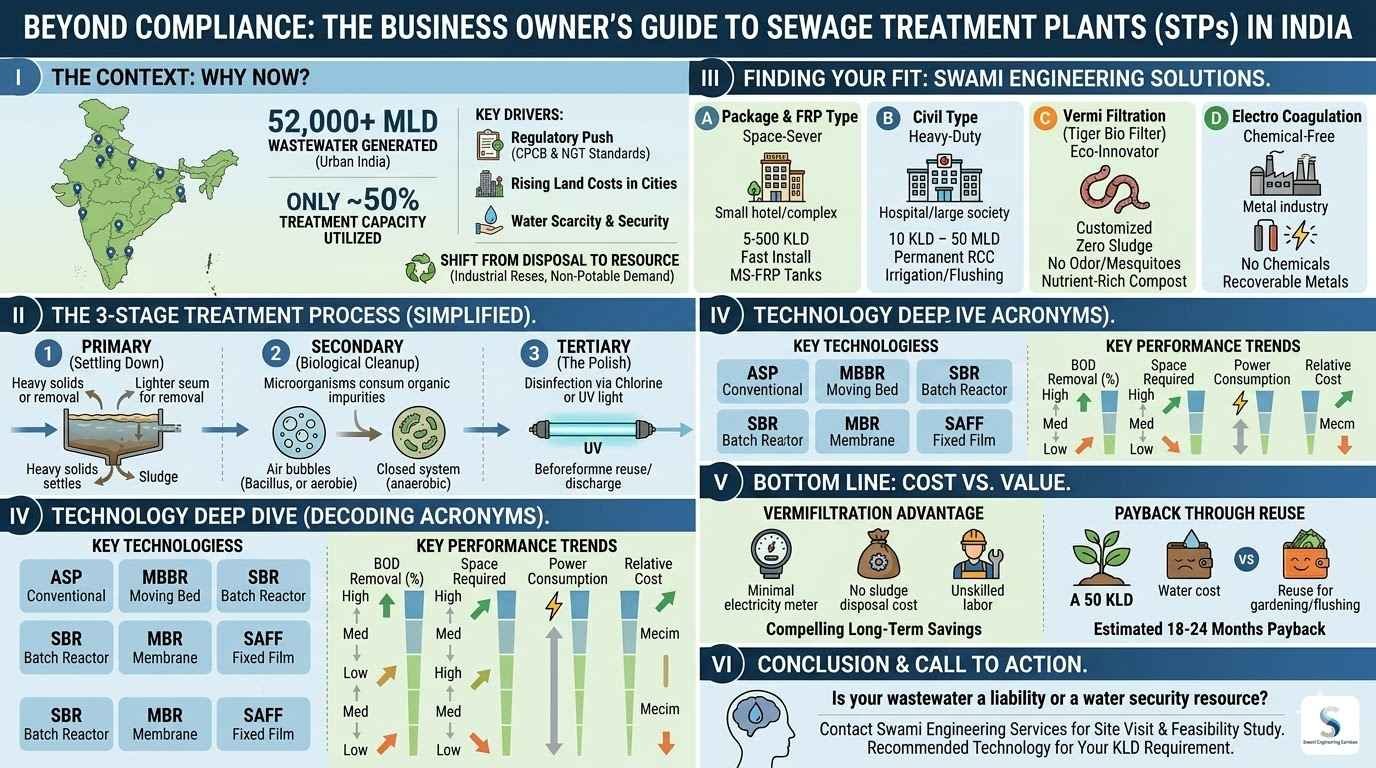
Go through below infographics